Hockey Lemieux: Why Mario Became Larger Than the Game
Mario Lemieux is listed among hockey’s rarest figures: not merely a dominant scorer, but a defining presence whose name carries cultural and sporting weight. From being the first overall pick in 1984 to a career that combined sublime skill, resilience and franchise stewardship, Lemieux's story explains how a player becomes larger than the statistics he produced.
At a glance: First overall pick in 1984, career totals of 690 goals and 1,723 points, six Art Ross Trophies, three Hart Trophies, two Stanley Cups as a player, and later principal owner who rescued the franchise from bankruptcy.
Quick access: WHAT MADE HIM LARGER THAN A PLAYER | THE PLAYING IDENTITY | VISUAL MEMORY
WHAT MADE THE FIGURE FEEL LARGER THAN A PLAYER
The first clue that Lemieux transcended ordinary greatness is the scale of his influence across roles: elite scorer, comeback figure after illness, and ultimately a franchise savior as owner. His achievements—leading the league in scoring multiple times and earning repeated MVP recognition—established obvious on-ice superiority. Paired with the decisions he took off the ice, those facts turned public admiration into lasting cultural weight.
Legend requires both sustained excellence and moments that reframe public perception. Lemieux delivered long-term statistical dominance (including 690 regular-season goals and 1,723 points) and also supplied dramatic narrative arcs that made his name a touchstone for resilience and leadership.
THE PLAYING IDENTITY
Lemieux’s hockey substance rests on three allied elements: scoring mastery, elite vision, and an unusual technical reach. He won six Art Ross Trophies as the league’s top scorer and three Hart Memorial Trophies as MVP—clear evidence that his performance drove results season after season.
Describing his style, authoritative retrospectives highlight elegance and technical capacity: the ability to control pace, create high-probability scoring chances, and finish at an elite rate. Those qualities explain why he repeatedly led his peers in production and why teammates and opponents remembered him as a match-defining presence.
ERA, CONTEXT, AND COMPETITIVE IMPACT
Lemieux arrived as the first overall pick in 1984 and spent his entire playing career with the Pittsburgh Penguins across parts of 17 seasons (a span from 1984 through 2006 that included retirements and comebacks). He helped reshape the Penguins from a franchise with potential into a championship contender, winning back-to-back Stanley Cups as a player in 1990–91 and 1991–92 and earning the Conn Smythe Trophy in both postseasons.
Context matters: Lemieux’s scoring titles and MVPs came at moments when the NHL’s top players competed for space and influence, and his sustained ability to lead the league in production made him a benchmark against which contemporaries were measured.
MOMENTS THAT FIXED THE IMAGE
Certain career episodes condensed public memory. His back-to-back Stanley Cup runs with Pittsburgh and the consecutive Conn Smythe awards fixed an image of clutch leadership in the playoffs. Another defining narrative was his 1993 return from treatment for Hodgkin’s lymphoma: diagnosed in January and returning to play on March 2, 1993, he still finished that season as the league’s scoring leader with 160 points. That combination of personal adversity and elite performance reinforced the perception of exceptional character alongside brilliance.

VISUAL MEMORY AND SYMBOLIC PRESENCE
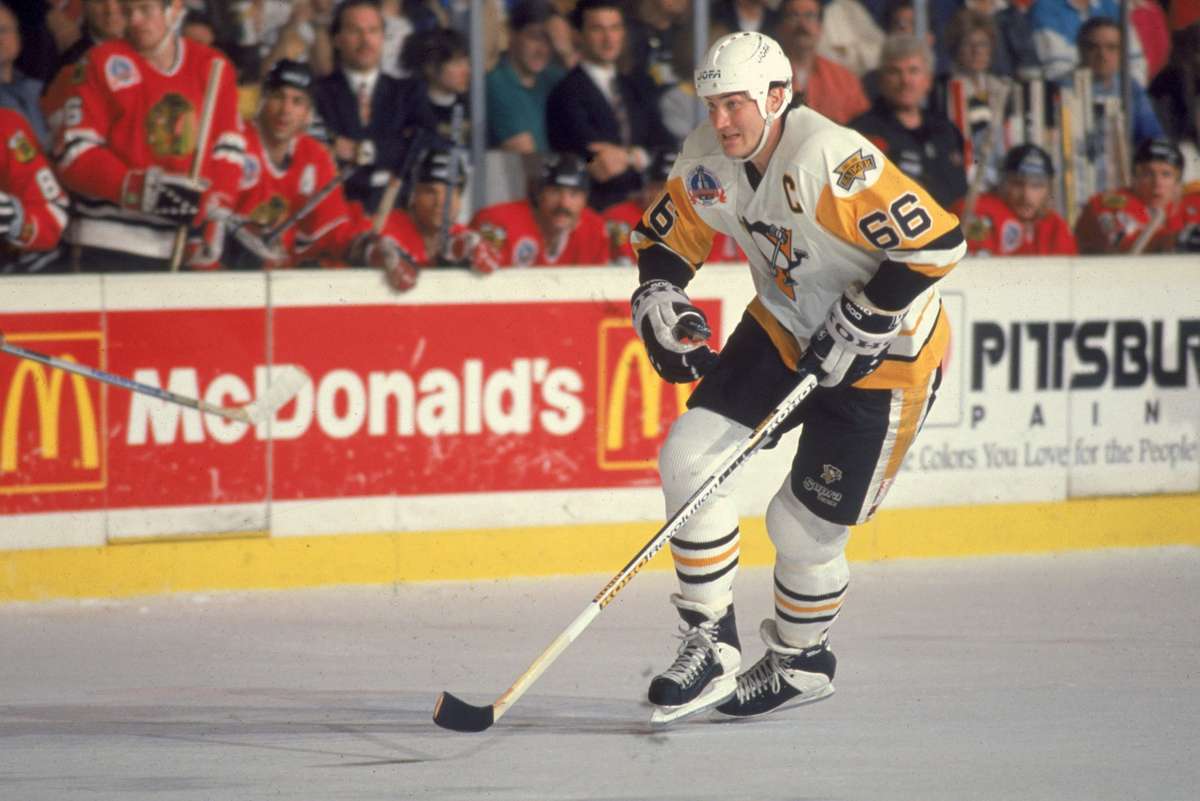
Legend survives in images. Lemieux’s silhouette—his size at the puck, his skating posture, and the Penguins jersey—translated well into memorable photographs and posters. Visual clarity helps a figure become a cultural reference: a few iconic frames can carry a career for generations, and in Lemieux’s case the combination of technical grace and high-production results created visually arresting moments that designers and fans return to often.
OWNERSHIP, FRANCHISE IMPACT, AND CULTURAL WEIGHT
Beyond play, Lemieux’s decision to lead a group that purchased the financially troubled Penguins in 1999 and become principal owner converted on-ice legacy into institutional legacy. He converted deferred salary into equity, helping save the franchise from bankruptcy and later supporting efforts that stabilized the team. That transition—from superstar to owner who later returned to play in 2000—made him unique in modern hockey history and expanded the ways his name carries influence.
His role in the franchise’s recovery and later championships under his ownership role reinforced the idea that Lemieux’s impact was structural, not merely statistical.
WHY THE NAME STILL MATTERS NOW
Newer generations inherit legends through trophies, Hall of Fame citations and franchise lore. Lemieux’s induction into hockey’s highest institutions and his listing among the game’s greatest players keep his presence active in hockey conversations. His career totals, awards and visible acts of stewardship form a multi-dimensional legacy that continues to offer meaning—both as a benchmark for elite skill and as a template for athlete-led franchise rescue.
CLOSING INTERPRETATION
Mario Lemieux became larger than a player because his career combined transcendent skill, decisive moments of resilience, and consequential stewardship of a franchise. The measurable facts—dominant scoring seasons, Hart and Art Ross trophies, two Stanley Cups as a player, a return from serious illness, and later ownership that saved the Penguins—create a layered legacy. That mixture of elite on-ice identity and off-ice agency explains why his name remains a durable landmark in hockey culture and in poster-worthy visual memory.
Author: Alex R.